
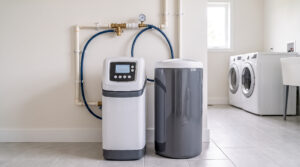
 The quality of your home’s water plays an important role in your family’s health and everyday well-being. Once your water has been tested, you can determine whether you need a point-of-use system, whole-house treatment or a combination of both. Many plumbing professionals recommend using both systems because they address different water-quality needs throughout the home.
Reverse Osmosis for Cleaner Drinking Water
A reverse osmosis (RO) system is a popular point-of-use solution designed primarily to provide purified drinking water at the kitchen sink. The system uses a separate faucet, while the equipment is conveniently installed beneath the sink.
RO systems are designed to reduce many contaminants, including lead, arsenic, pesticides and certain microorganisms, while also reducing fluoride. Because an RO system is generally designed to supply drinking and cooking water rather than treat the volume needed throughout an entire home, it is typically used as a point-of-use solution.
Whole-House Filtration for Water Throughout Your Home
While an RO system focuses on drinking water, a whole-house filtration system treats water as it enters your home. For public water supplies, a whole-house filter can use granulated activated carbon to improve taste and reduce chlorine or chloramine used during water disinfection.
Whole-house filtration can also help address unpleasant tastes and odors, as well as cloudiness and other aesthetic concerns that may develop as water travels through distribution pipes and household plumbing. By treating water throughout the home, the system provides filtered water at faucets and showerheads and can help reduce the buildup of substances that may affect plumbing fixtures and appliances.
Could Your Home Benefit From a Water Softener?
If testing reveals that your home has hard water, a water softener may be another important part of your water-treatment system. Water hardness is caused by dissolved minerals, primarily calcium and magnesium. When hardness exceeds approximately 7 grains per gallon, homeowners may want to consider whether softening is appropriate for their household. Homes in this area can often have hardness levels of 10 grains per gallon or more.
Hard water can leave stubborn mineral stains on sinks, toilets and bathtubs, while deposits can accumulate on showerheads, cookware and glassware. It can also make soaps and laundry detergents less effective, potentially leaving clothing and linens looking dull and contributing to premature fabric wear. Many homeowners also notice the effects of hard water on their hair and skin.
Test Your Water Before Choosing a Solution
There is no one-size-fits-all approach to water treatment. The best system for your home depends on what your water test reveals and what you want to accomplish. A combination of point-of-use filtration, whole-house treatment and water softening may provide comprehensive treatment, but the first step is understanding your home’s specific water-quality concerns.
