
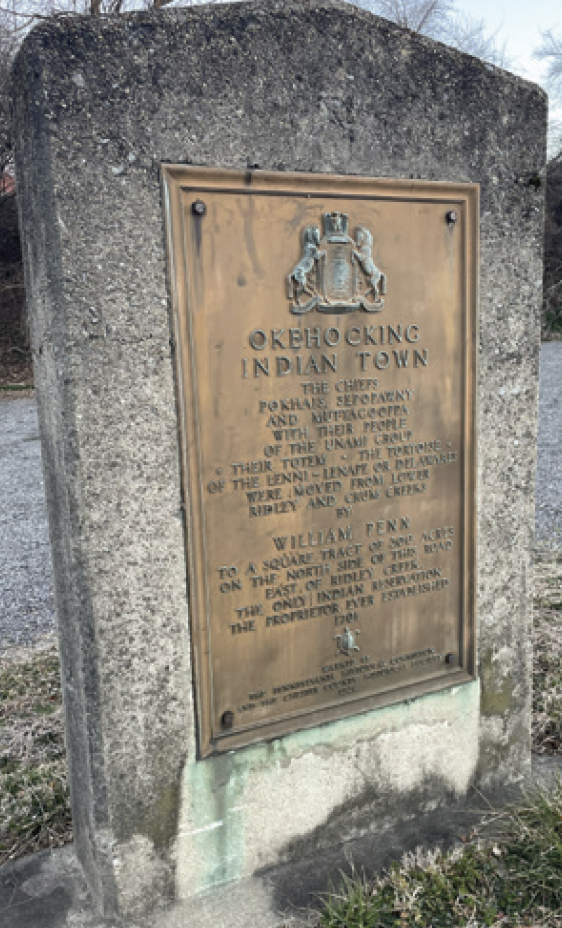
Before William Penn, the Swedes and Dutch settled the Delaware Valley, there were the native Indians – who arrived approximately 12,000 years before. Unlike the Incas and other Indian civilizations to the south, they were not builders, they had no written language, and the only traces of civilization that they left for us to decipher were their tools and weapons. They were hunter/gatherers, moving between locations seasonally in search of game and wild plants. When the Europeans began showing up along the coast, trade developed between the groups. But as these interactions increased, the natives were exposed to new germs and diseases, and their numbers had dwindled by the time William Penn and his colonists began arriving in 1682.
The natives who remained in Chester County were the Okehocking Clan, of the Unami tribe, one of three Lenni Lenape tribes in the Algonquin nation. Lenape was their name for the Delaware River, and so the English settlers called them the Delaware Indians. The Unamis’ tribal symbol was the tortoise, representing mother earth.
The Unamis, losers in Indian wars of the late 17th century, had been disarmed as a result. They were peaceful and staged no raids on the settlers. However, there was a culture clash – the English system of ownership of property. The natives never took to the idea of invisible lines that stopped them from hunting or gathering at a certain place. The small remaining band of about two dozen Okehockings in Chester County in 1701 petitioned William Penn to grant them land to be used exclusively for their purposes. Local Quaker farmers were agreeable to this suggestion, walked the land with the natives, and selected a 500-acre tract near the intersection of what is now West Chester Pike and Delchester Road. A key feature for the natives was a rock that jutted out from the ground, Turtle Rock.
The clan returned to this land during summers from 1701 till 1735, when they joined the larger nation in moving west. The land reverted to the Yarnall brothers. Archeological surveys since then have found very little evidence of their occupation. They lived in tent-like structures in summers and so left little trace of their visits.
155 acres of the original grant are now a public park, the Okehocking Preserve in Willistown. A historic marker was placed along the West Chester Pike frontage in 1924 to remember this last Okehocking Clan.
For more history on Newtown Square, Delaware County, and membership information, please visit our website at www.nshistory.org.
