
 The first “9-11” tragedy in American history was the Battle of Brandywine on September 11, 1777. American farmers fought shoulder-to-shoulder with Washington’s army against the seasoned British and Hessian forces. By nightfall, the Americans had retreated toward Chester, leaving the enemy free to raid the countryside for food and supplies.
One of those raids reached what was then Edward Russell’s farm, known as Hunting Hill in Edgmont Township. As chronicled by historian Henry Graham Ashmead in 1884:
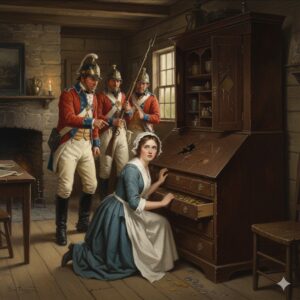
“On September 17, 1777, a party of English soldiers visited the residence of Edward Russell, on the farm known as Hunting Hill, and while in the house they broke into a secretary, where, in a secret drawer, one of the daughters had secreted a sum of money. The soldiers had not discovered the hiding-place, had turned, and were about leaving the room, when the owner of  the money, in her anxiety for the treasure, went to the desk and opened the drawer. Her action was observed by one of the men, who compelled her to deliver to him the savings of many months. The desk, still showing the marks of the force used to open its apartments, is now in possession of Burgess Green, of Media.”
Today’s Hunting Hill Mansion in Ridley Creek State Park stands on land that once belonged to the Russells. The 1915 mansion enlarged upon an existing farmhouse dated to 1789, which may not be the original Russell home that was raided in 1777. Yet the name Hunting Hill also refers to the high ridge that crowns the park—a commanding point that still bears traces of the early families who farmed there.
Hidden along the Hunting Hill Loop Trail in the Park is the Russell family cemetery, overgrown and forgotten. Only seven stones are legible today, but early records show William Russell and his wife, Mary Henly, raising seven children in this vicinity during the eighteenth century. The family were known as saddle makers, a trade that required good leather, tools and ready cash—explaining why British foragers may have considered their home a tempting target.
Ashmead recorded another nearby episode of wartime plundering in Edgmont: the house once owned by Abel Green, where British soldiers bored into a whiskey barrel with a musket ball and poured “round after round” for themselves. Such vignettes remind us that behind the great battles of the Revolution were the daily risks endured by local farmers whose homes stood in the path of war.
The forest has reclaimed Hunting Hill, hiding the evidence of the early Russells—their homes, barns and lives. It takes a little digging to find them and to reconnect with their history and their contributions to Edgmont Township.
For more history on Edgmont Township, Delaware County, and membership information, please
visit our Facebook group at https://facebook.com/groups/edgmonthistoricalsociety/