
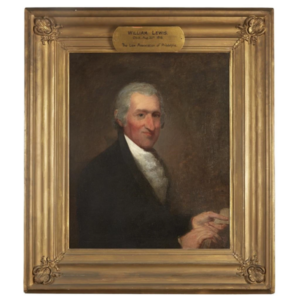
Gilbert Stuart
Who was Edgmont’s most famous native son? If you asked the question in the 18th and early 19th century, the answer would likely have been the Honorable William Lewis. Descended from the Lewis family that were settlers in Haverford, Newtown and Radnor, William was born in 1751 at
a still extant stone farmhouse on his father’s 200-acre farm, later known as the Smedley farm on Stackhouse Mill Road in Edgmont. In 1768, the 17-year-old farm boy took a load of hay to market in Chester, and while there, he walked into the county courthouse and it changed his life.
Well-dressed men dueled with words in front of a distinguished judge. And were paid to do so! He watched the trials being held that day, and then rode home in his wagon, dreaming of a new future for himself.
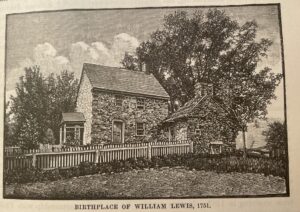
where William Lewis was born
There were few lawyers in farming communities, so William moved to Philadelphia and took a job as an office boy in the law office of noted Quaker attorney Nicholas Waln. He “read the law” and learned from observing and being instructed by Waln. In 1772, Waln walked by the Pine Street Quaker Meeting and was drawn in by a woman preacher, then seized by voices and visions, fell into a trance and when he came to, he renounced all worldly connections, turned his lucrative law practice over to young William Lewis, and became an itinerant Quaker minister for the remainder of his life.
Lewis became a very successful criminal attorney, noted for his defense of many Quaker leaders who
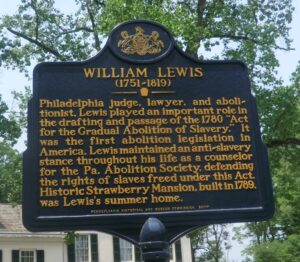
outside of Historic Strawberry Mansion
celebrates the life of William Lewis
were jailed, charged with treason and had their properties confiscated for not supporting the American Revolution. He was elected to the legislature, took part in the revision to the Pennsylvania Constitution, and was appointed by Washington to serve as U.S. Attorney for Pennsylvania. Later appointed a District Judge, he found that life uncongenial and the pay too low for his lifestyle, and so resumed the practice of law. In 1780, he played a leading role in the passage of the “Act for the Gradual Abolition of Slavery,” the first time an elected body had ever abolished slavery.
In 1789, Lewis bought land along the Schuylkill River and built a summer home, called “Summerville.” He enjoyed 30 summers on the river, dying there in 1819. But you can still visit his house, which we now know as Historic Strawberry Mansion in Fairmount Park.
For more history on Edgmont Township, Delaware County, and membership information, please visit our Facebook group, “Edgmont Historical Society”.