
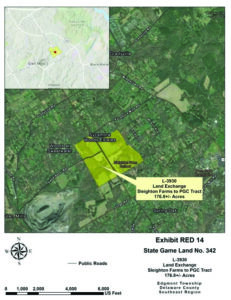
 For generations, the rolling hills and wooded fields along Valley Road in Edgmont Township have been home to the historic Sleighton School campus. Many longtime residents remember the property as a girls’ school set amid farmland, stone buildings, and quiet country roads. Now, after years of uncertainty about its future, a significant portion of the land is expected to be preserved as protected open space through acquisition by the Pennsylvania Game Commission.
The proposed plan would convert approximately 177 acres of the former Sleighton School property into state game lands. If finalized, the land would be permanently protected and managed for wildlife habitat and outdoor recreation. The proposal has drawn strong interest from Edgmont residents, leading to a recent public meeting where representatives from the Pennsylvania Game Commission explained their plans and answered questions from the community.
The proposal involving the Pennsylvania Game Commission emerged from a land-swap arrangement that would allow the state agency to acquire the Edgmont acreage and designate it as Pennsylvania State Game Lands. If completed, it would become the first parcel of state game lands located in Delaware County.
At the recent public meeting, Game Commission representatives explained that the property would be managed primarily for wildlife habitat. The land would remain largely natural, with efforts focused on maintaining forests, grasslands and other environments that support deer, turkey, small game and numerous bird species.
Hunting would be permitted during regulated seasons, as it is on other state game lands across Pennsylvania. Officials emphasized that hunting activity is strictly managed with established seasons, licensing requirements and safety regulations.
The land would also be open to the public for non-hunting activities such as hiking, bird watching and nature observation. Many residents expressed support for preserving the land in its natural state while still allowing responsible public access.
Game Commission officials explained that most of the buildings would likely be demolished as part of preparing the property for its new role as a wildlife habitat. Maintaining aging institutional buildings would be costly and outside the agency’s mission, which focuses on land and habitat management rather than historic preservation.
Officials noted that once the buildings are removed, portions of the former campus may eventually be restored to fields or forest, depending on habitat needs. In some areas, grasslands may be maintained to support ground-nesting birds and other wildlife that thrive in open meadows.
Public access points would be limited and carefully planned, likely including small parking areas or trail access rather than large recreational facilities. State game lands are designed to remain relatively undeveloped so that wildlife habitat remains the primary focus.
Residents at the meeting asked questions about safety, property boundaries and how the land would be patrolled. Game Commission representatives explained that state game lands are regularly monitored by wildlife conservation officers who enforce hunting regulations and ensure that the land is used responsibly.
“The possibility of preserving nearly 177 acres of open space in Edgmont is incredibly exciting for many residents,” said Edgmont Township Board of Supervisors Chair Annie Thorne. “We appreciate the opportunity to bring the Pennsylvania Game Commission and the community together to discuss the proposal and answer questions. It was encouraging to see so many residents engaged in a thoughtful conversation about the future of Sleighton, and we look forward to continuing that dialogue as the acquisition process moves forward.”
For many people in attendance, the proposal represented a rare opportunity. In a region where development continues to reshape the landscape, permanently protecting nearly 200 acres of land is increasingly uncommon.
While the buildings that once defined Sleighton’s campus may eventually disappear, the land itself will remain open and protected for generations to come.
The fields and woods that once served as the backdrop for a school community could soon become something different but equally meaningful: a preserved natural space where wildlife thrives, and residents can continue to experience the quiet beauty that has long defined this corner of Edgmont Township.