
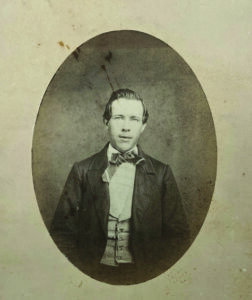
 For families with deep roots in Edgmont Township, history is often measured not just in years but in centuries. Few names are woven into the story of the township as thoroughly as Smedley. Long before the United States declared its independence, members of the Smedley family were already
farming, worshipping and building lives in our community. Their homes and their values stood as silent witnesses to the birth of the United States in 1776, and generations later, their descendants would continue to leave a lasting mark on the region and beyond.
The American branch of the family traces its beginnings to George Smedley, a Quaker who arrived in Pennsylvania around 1682. Like many early settlers, he was drawn by William Penn’s vision of a colony founded on religious freedom and tolerance. The family established itself in what is now Delaware County and soon became part of the area’s growing Quaker community. Over the decades, generations spread into Edgmont and neighboring townships, where they built farms and homes that became fixtures of the landscape.
By the time the American colonies broke from Great Britain in 1776, the Smedleys had already been living in Pennsylvania for nearly a century. Their houses, fields and meeting places witnessed the dramatic changes unfolding around them. As Quakers, the family adhered to principles of peace and conscientious objection. Those beliefs often placed friends in a difficult position during times of war, when loyalty and patriotism were measured differently than they are today. While battles raged and the Continental Congress debated independence, Quaker families such as the Smedleys sought to remain faithful to their convictions while continuing to serve their communities.
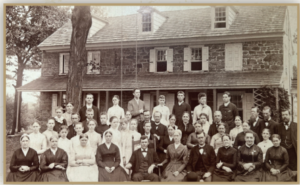 The generations that followed carried those same principles forward. During the Civil War, cousins Edward and William Smedley refused military service because of their Quaker beliefs. Their decision reflected a commitment to peace that had been part of the family’s identity for generations. Though such choices were often misunderstood, they demonstrated a remarkable consistency in values passed down through the centuries.
Among the most accomplished descendants was Samuel Lightfoot Smedley, born in Edgmont in 1832 to Samuel and Hannah Pennell Smedley. Raised in an old Quaker family, he attended Westtown School and later taught at the Edgmont Central Seminary before pursuing a career in surveying. What began as a practical profession became a lifetime of extraordinary achievements.
Samuel’s skill with mathematics and drafting soon brought him to Philadelphia, where he became one of the city’s most influential engineers and planners. In 1856, he was chosen to lay out the streets of Blockley Township, now part of West Philadelphia. Six years later, he published a complete atlas of Philadelphia, a resource that historians still value today. His career included service on the Board of Surveyors and 15 years as the city’s Chief Engineer.
His influence can still be seen in some of Philadelphia’s most recognizable landmarks. Samuel oversaw the design and construction of the Penrose Ferry Bridge and the Fairmount and Girard Avenue bridges. Yet perhaps his greatest legacy emerged from a trip to Europe in 1865. Inspired by the grand public parks he encountered there, he returned home determined to create something similar for Philadelphia. Through his efforts, the city
acquired the Lansdowne estate along the Schuylkill River, creating what would become Fairmount Park, one of the largest urban park systems in the nation.
Samuel’s interests extended well beyond engineering. He served as recording secretary of the Historical Society of Pennsylvania and belonged to numerous organizations, including the Delaware County Institute of Science, the Academy of Natural Sciences, the Franklin Institute, the American Public Health Association and the American Society of Civil Engineers. He understood the importance of preserving knowledge and documenting the past, a fitting pursuit for someone whose own family history stretched back nearly two centuries.
When Samuel died in 1894 at his West Philadelphia home, a simple Quaker service reflected the humility with which he had lived. A wreath from the Board of Surveyors provided the only floral tribute, while numerous city officials gathered to pay their respects. He was laid to rest at Middletown Friends Meeting Cemetery, not far from the land where generations of Smedleys had established their roots.
Today, as America celebrates its 250th birthday, the story of the Smedley family reminds us that history is not found only in famous names and battlefield victories. It also lives in the families whose homes stood before independence was declared, whose convictions remained steady through changing times and whose descendants helped shape the communities around them.
The Smedleys of Edgmont were among those quiet witnesses to history. Their houses saw the dawn of a new nation. Their values survived centuries of change. And their legacy continues to enrich our community, serving as a reminder that preserving local history helps us better understand the larger American story.